Geometric Design part 2
Welcome back. This is some of my favorite content relating to design and the natural world.
We're going to kick this off with the ubiquitous golden section, which is derived from the divine
proportion. The various shapes that emerge from this proportion show up in the design of: man,
animals, plants, geology, Stonehenge, the pyramids, and much of what occurs around us. In the
mid 1800's, a psychologist named Gustav Fechner did an extensive study to determine the
proportions in rectangles that were most pleasing to humans, the golden rectangle won "hands
down".
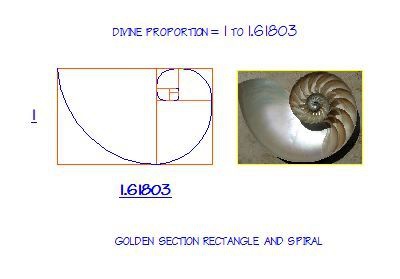
On the left is a series of nesting golden
rectangles, with a golden spiral described
in the rectangles. To the right is a
chambered nautilus shell, which reflects an
almost perfect golden spiral.
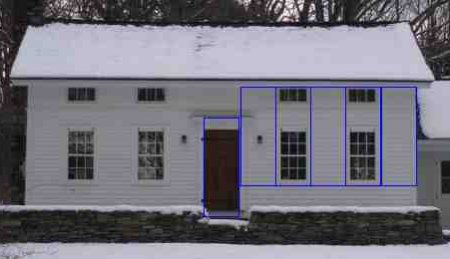
This will be our subject of analysis today. It is a
beautifully simple little house in my home town. I
have heard many people comment on it's
elegance and it will be interesting to explore
some reasons that it is so attractive. To get us
started, since we looked at the golden section,
let's see if the "GS" shows up in the overall
proportion.
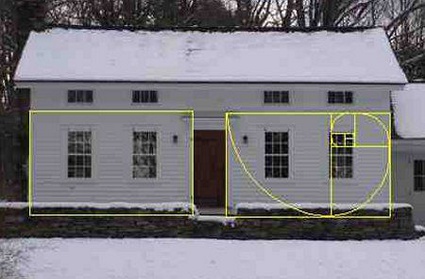
Looks like we "struck gold" on that idea. The main
facade of the house, vertically from the water table
to the architrave, and horizontally from the corner
to the door, is a perfect golden rectangle. If you
follow the spiral in the rectangle on the right side,
you'll notice that even windows and panes are
described by the main golden section. Let's look
for more GS relationships.
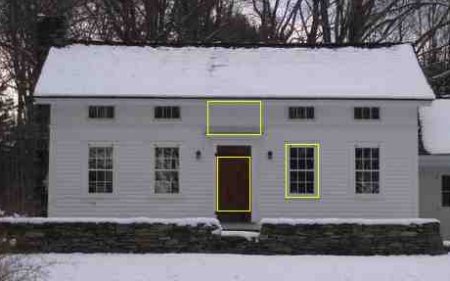
The lower windows, with trim, the area above the
door pediment, and the area of door between the
strap hinges are all identical golden rectangles.
As mentioned above, the window panes are all
identical golden rectangles. If we keep looking,
I'm sure we'll find innumerable examples of this
rectangle in the various details. Let's see what
other patterns are occuring in this facade.
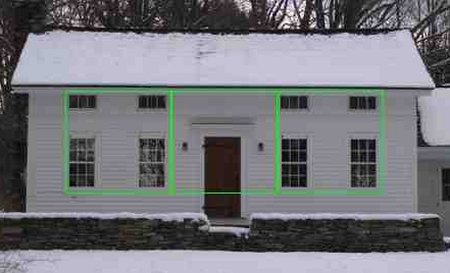
It seems that the window and doorway areas can
be described by three identical squares, an
organizational system that seems innately sensible.
On the subject of repeating elements, a basic
component to visual harmony, it seems that the
area that describes each upper and lower window,
as well as the door to the top of the pediment, is a
multiple of the overall width of this part of the
house. I'm also noticing that the stone wall is
approximately the same height as the width of the
windows and doors. What other repeating
geometry can you find?
My purpose in writing these blogs is to do my small part in raising expectations in the area of design. The
design can be architecture, graphics, or anything that is conceived of by humans. Lets hold ourselves, and
anyone working with us, to the same standard of excellence that the designer of this house held himself to.
Let's not compromise to allow room for a larger flat screen tv, jacuzzi, or favorite couch. A crucial element in
"green" constuction is longevity and durability. If we build houses that are durable enough to last 50 or 100+
years, they have to be designed in a "timeless" enough fashion that someone will want to keep the basic
structure and appointments of the building intact after fads and trends have changed. Unfortunately, beautiful
and timeless design is too rare in the landscape of new construction (with some very nice exceptions). If you
type "geometric design" or "sacred geometry" into google, you'll find plenty of interesting reading. Please
forward this to anyone that could find it useful.
Classic Architecture Meets Sustainable GreenTechnology